

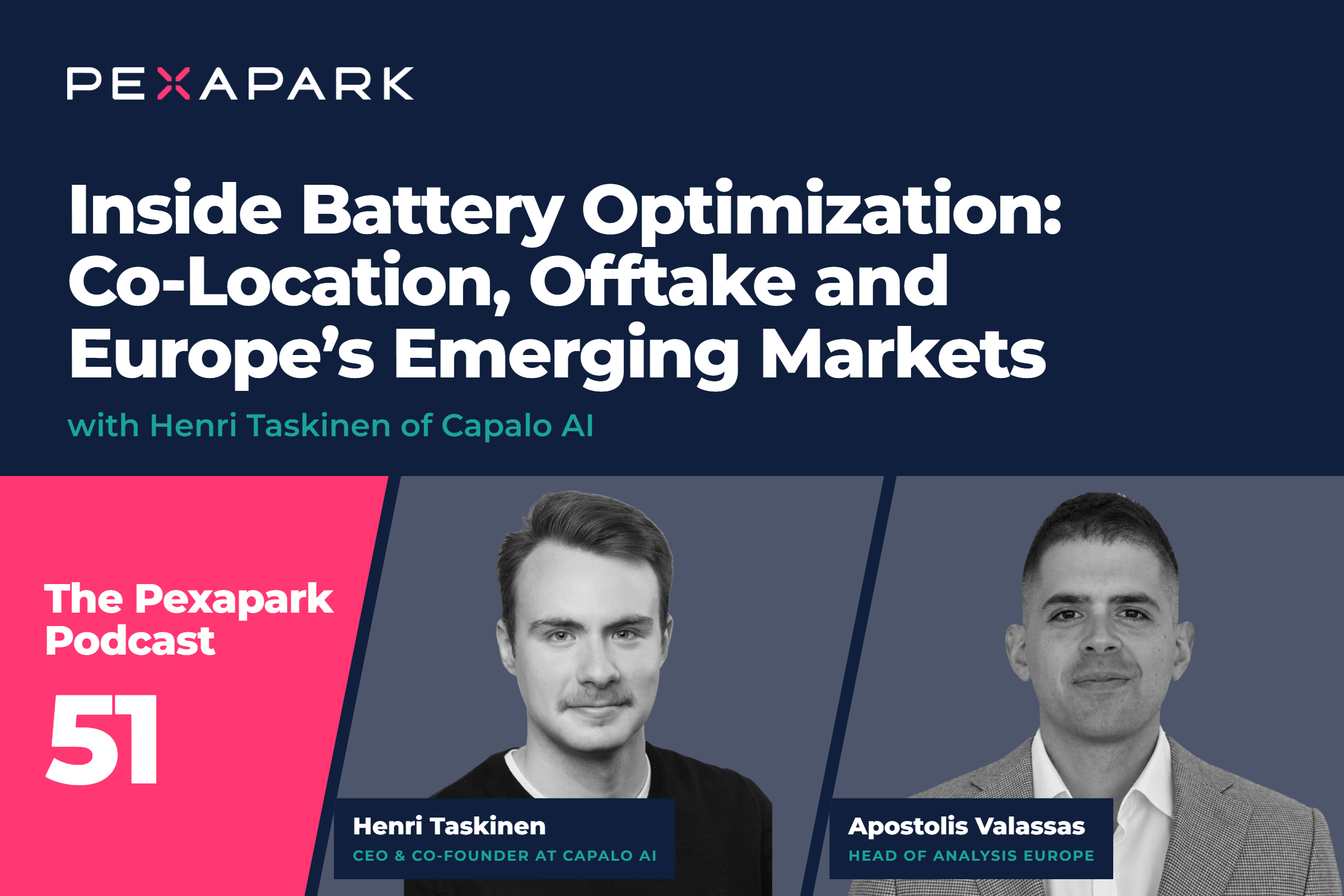


Henri Taskinen, CEO and Co-Founder of Capalo AI, joins host Apostolis Valassas to unpack how the company trades and optimizes standalone and co-located batteries across Europe. The conversation covers what sets an independent, end-to-end optimizer apart in a crowded market.
Capalo AI is active in seven markets, with plans to reach 11, and has 1.8 gigawatts under contract, of which around one gigawatt is live. The discussion explores how local expertise, pre-qualification speed and the move toward wholesale-driven revenues shape returns, and why floors and tolls matter for bankability.
In the second part of the episode, Apostolis turns to recent Pexapark market intelligence. He covers Spain’s revised data center decree, the speculative grid requests in Central and South Eastern Europe, and what US data center moratoria could mean for European investment.
Key takeaways
- 1Revenue stacks shift from ancillary services to arbitrage. Finland and the Baltics moved from FCR and capacity payments toward day-ahead and intraday arbitrage, and the same pattern is expected in other markets.
- 2Fast pre-qualification protects battery returns. Capalo AI has pre-qualified close to one gigawatt of batteries, including the first asset for mFRR in Bulgaria and the first commercial battery in Lithuania, because delays hurt revenues, especially under floors.
- 3Floors and tolls are the most bankable offtake structures. Capalo AI focuses on routes to market while partners such as utilities and trading firms price the deals and provide balance sheet strength for lenders.
- 4Co-location demands tailored optimization, not one template. Shared grid connections, export limits, and different PV, battery power and duration ratios mean each hybrid park needs its own approach, and Capalo AI already optimizes 19 hybrid parks.
- 5Standardized hybrid offtake could accelerate the industry. Henri expects more offtakers and more mature, standardized hybrid structures to make hybrid parks a crucial part of the industry in the next few years.