


Democratic gains bring calls for data center moratoriums and tougher regulations across one of the nation’s fastest-growing power markets.
States across the Midcontinent Independent System Operator (MISO) market emerged as ground zero for the Democratic blue wave in November’s midterm elections. The political shakeup could put billions of dollars in planned data center investments at risk, potentially slowing electricity demand growth, supporting renewable energy development, and higher PPA valuations.
Democrats gained full control of state governments in Michigan, Minnesota and Wisconsin, and captured the governorship in Iowa. The political shift brings to power elected officials pushing for stricter oversight of data center development. The incoming governors of Michigan and Wisconsin have all called for moratoriums on new projects as part of broader efforts to shield ratepayers from rising electricity costs.
A massive wave of data center-driven electricity demand growth is at stake across MISO, which operates the wholesale power market across all or parts of 15 states, from Montana to Louisiana. The grid operator projects data center load could reach 20 GW by 2030, equivalent to roughly 16.5% of MISO’s 121 GW peak demand in 2025. In its 2026 long-term load forecast, MISO projects annual load growth of 2%, up from 1.6% in its 2024 forecast.
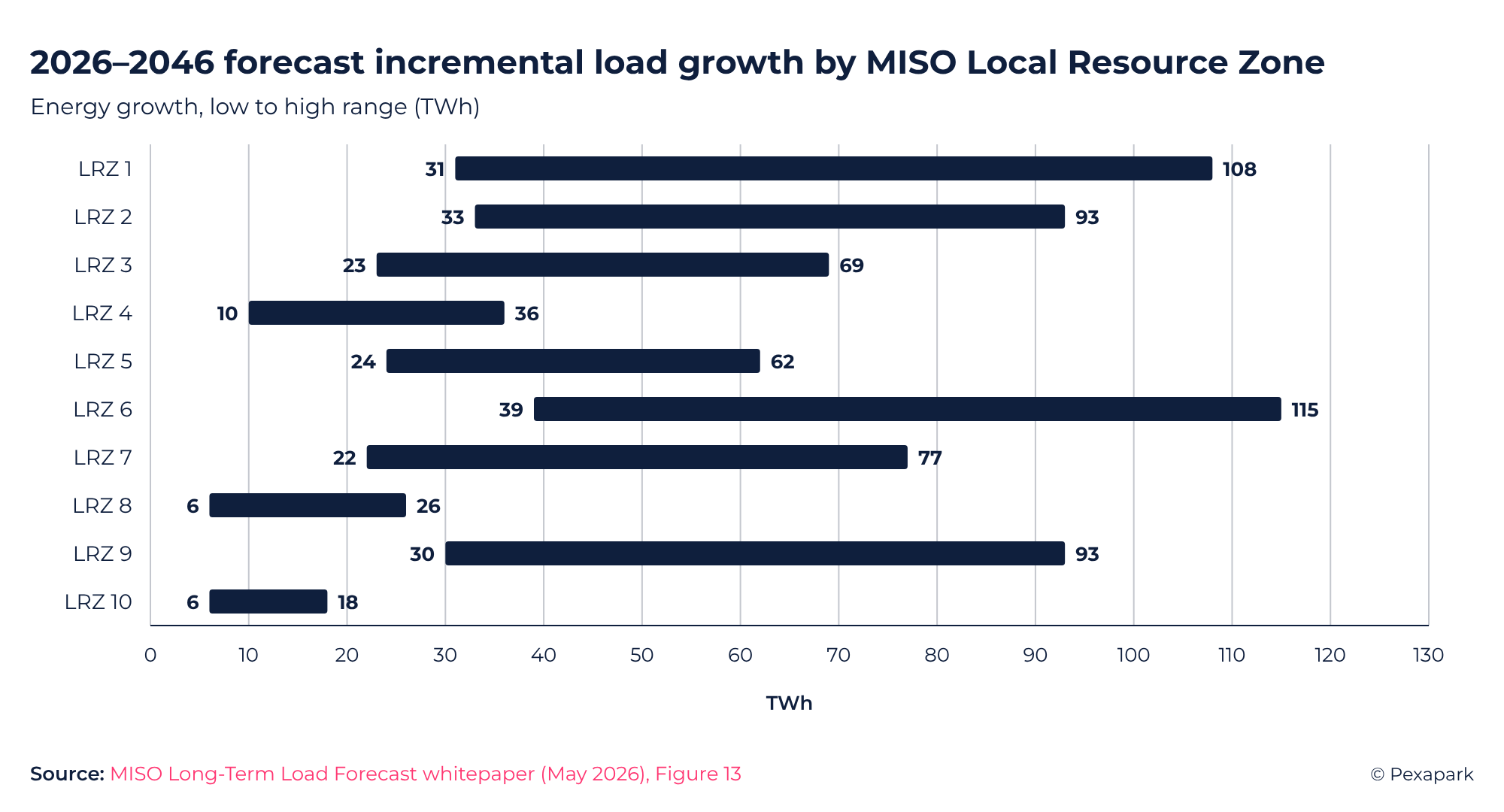
IIn Wisconsin, Democrats secured their first governing trifecta in 16 years after winning majorities in both legislative chambers. The shift could empower Governor-elect David Crowley to pursue his campaign proposals to eliminate data center tax exemptions, require developers to shoulder infrastructure upgrade costs, and impose a moratorium on new data centers. Eastern Wisconsin sits within MISO’s Local Resource Zone 2 (LRZ 2), where electricity demand is projected to increase by 33-93 TWh between 2026 and 2046.
Michigan’s Democratic trifecta could see a similarly sharp shift in data center policy. Like Crowley, Governor-elect Jocelyn Benson has proposed a moratorium on new data centers until enforceable safeguards are established, eliminating tax breaks and requiring developers to cover their electricity costs. Michigan’s Lower Peninsula, which accounts for most of the state’s projected load growth, falls within MISO’s Local Resource Zone 7 (LRZ 7), where electricity demand is forecast to increase by 22-77 TWh between 2026 and 2046.
In Minnesota, Democrats flipped the state House to gain full control of state government, giving Governor-elect Amy Klobuchar greater power to pass legislation and impose regulations on the industry. During her campaign, Klobuchar emphasized preserving local governments’ authority over data center projects and ensuring that existing utility customers do not subsidize new developments. Minnesota sits almost entirely within MISO’s Local Resource Zone 1 (LRZ 1), which also covers all or parts of Montana, North Dakota, South Dakota, and western Wisconsin. MISO projects electricity demand in the zone will increase by 31-108 TWh between 2026 and 2046.
In Iowa, Democrats broke the Republican trifecta by winning the governorship. Governor-elect Rob Sand has proposed requiring data center operators to pay 100% of their electricity and infrastructure costs, eliminate state tax incentives, and strengthen local oversight. MISO projects that electricity demand in Local Resource Zone 3 (LRZ 3), which covers most of Iowa and southern Minnesota, will increase by 23-69 TWh between 2026 and 2046.
Navigating ERCOT & PJM Clean Power Markets?
Learn how Pexapark’s price intelligence helps you spot market opportunities and act with confidence. Book a demo >