


Our market experts frequently share sharp, data-led perspectives on the trends reshaping renewables. To read more, register with Pexapark today for your free month access.
Realized solar revenues in Germany reached a new high in October since 2022, pushing the 2026 yearly market value toward more than 60 EUR/MWh and leaving most newer EEG ground-mounted assets unlikely to receive a top-up.
In October 2026, the Pexapark Renewable Price (PRP), the realized day-ahead market value of solar, reached 138.3 EUR/MWh, the highest monthly level for German solar since the 2022 energy crisis.
The monthly market value under the EEG came in slightly lower, at 133.9 EUR/MWh, reflecting methodological differences in the underlying generation profiles used to calculate the two indices.
The annual market value for solar is expected to finish 2026 above 60 EUR/MWh. It stood at 63 EUR/MWh at the end of October, substantially above the 46 to 47 EUR/MWh recorded in 2024 and 2025. Elevated power prices toward year-end could push the annual value slightly higher, although low solar generation volumes in November and December mean these months are unlikely to materially affect the annual price.
The increase in market value is particularly notable given the substantial growth in solar generation. As of November 12, 2026, solar generation had already surpassed 82 TWh, exceeding the full-year 2025 total of 70 TWh by 17%.
Most EEG ground-mounted assets will see no top-up for 2026
At this level, most ground-mounted EEG solar assets that were awarded a subsidy over the past years will likely receive no top-up payment for 2026. The rise in realized solar values in the second half of 2026 has been supported by higher gas prices feeding through to wholesale electricity prices.
Economic curtailment lifts the yearly value to 85.4 EUR/MWh
A solar asset that curtails economically earns a clearly higher yearly market value: 85.4 EUR/MWh in 2026, against 65.5 EUR/MWh in 2025. This applies primarily to newer assets that no longer receive any EEG subsidy when day-ahead prices turn negative. The higher value comes at the cost of lower volumes.
So far this year, 22% of solar generation has occurred during negative price periods, down slightly from 24.2% last year. This marks a potentially important turning point: after several years of rapidly increasing exposure to negative prices, the trend appears to have stabilized despite continued growth in solar generation.
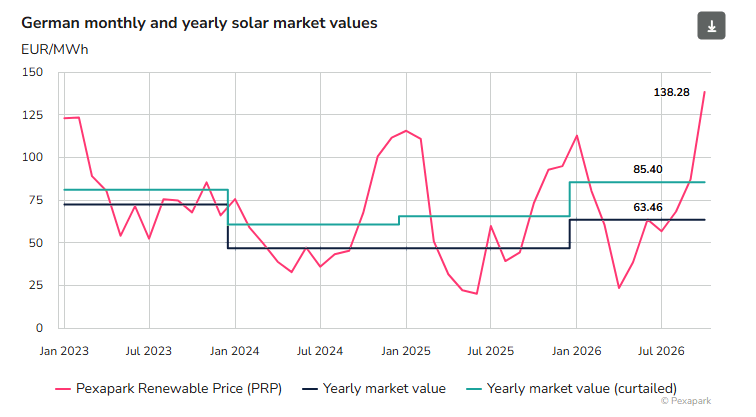
Monthly and yearly market values for solar in Germany (2023 – 2026 YTD, in EUR/MWh. Source: Pexapark Renewable Indices.