


PJM’s backstop would pay up to 555 USD/MW-day for 15 years, but falling storage ratings cut a battery’s average capacity value to ~5 USD/kW-month, close to TB4 Fair Values.
On 29 October, PJM filed an amended Reliability Backstop Procurement with the Federal Energy Regulatory Commission (FERC) to buy about 6,800 MW of capacity, the shortfall left when the 2028/2029 capacity auction cleared at its 325 USD/MW-day cap. Contracts would run for up to 15 years at a maximum MW-weighted average price of 555 USD/MW-day, 71% above the auction cap. Offers are due between 1 and 28 March 2027 and results on 10 May, after FERC accepted the design on 29 September but suspended it until 28 February 2027.
Under the filing, data centers would pay for the capacity their load requires. PJM would charge load-serving entities based on their share of large-load growth between the actual 2026 summer peak and the 2028/2029 forecast, and would subtract capacity already bought through bilateral contracts. American Electric Power (AEP) said it signed 15 GW of new load commitments in the third quarter, and FirstEnergy said its contracted large load reached 7.9 GW, nearly double the start of the year. On 5 November, PJM forecast a record winter peak of about 147,500 MW, up about 7,500 MW since 2022, mainly because of data centers.
On 3 November, Utility Dive reported that Jefferies analysts expect utilities’ 6.5 GW of cuts to near-term large-load forecasts to lower PJM’s January load forecast. This measure could shrink the procurement to as little as ~630 MW. PJM sets the final target on 28 April 2027, so the size of the purchase is still open.
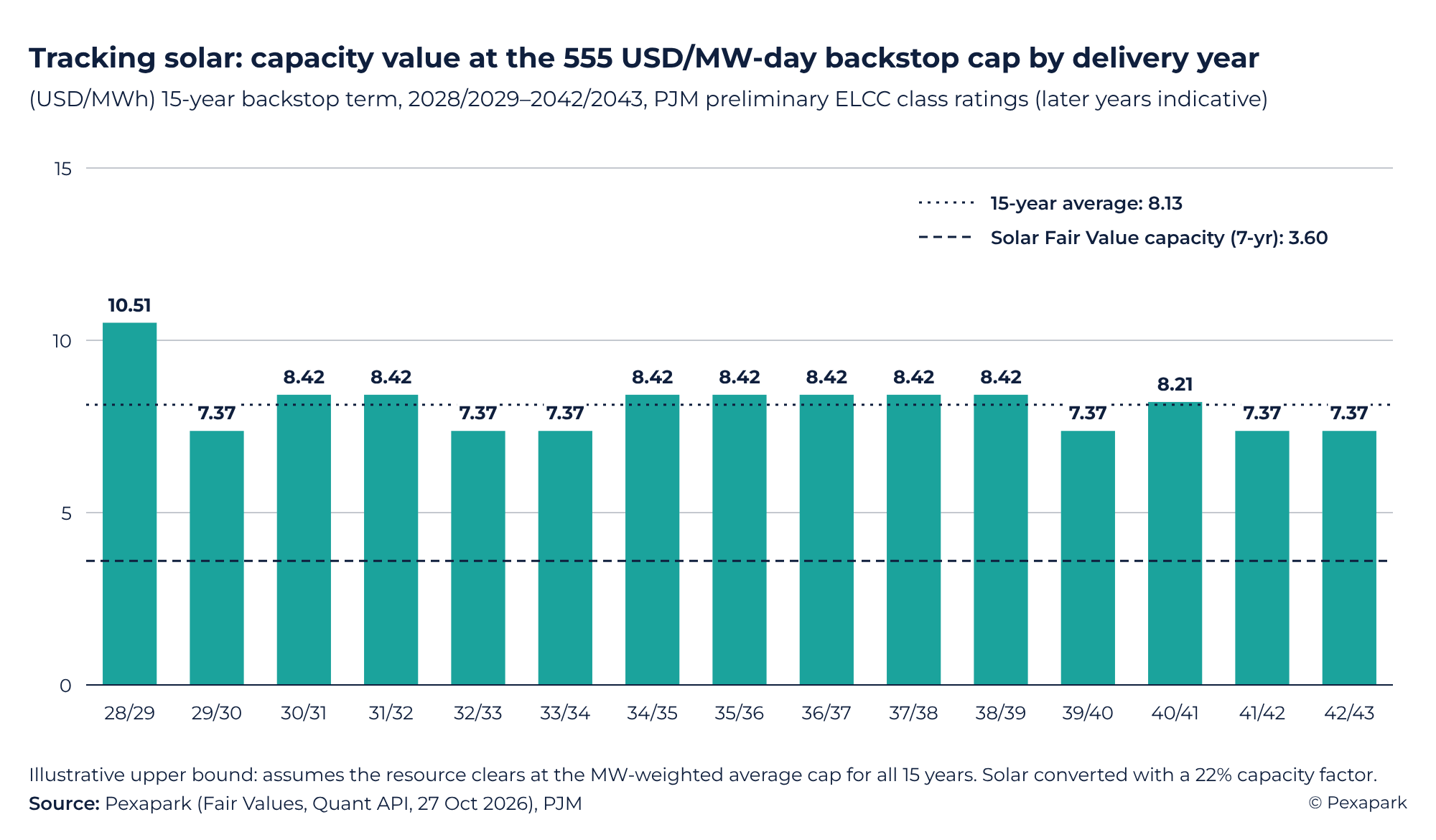
PJM’s preliminary capacity ratings, which run to 2042/2043 to cover the 15-year term, fall sharply for batteries. The 4-hour storage rating drops from 59% in 2028/2029 to 42% in 2030/2031 and 19% by 2042/2043, while tracking solar stays at 7-10%. We estimate that a new 4-hour battery clearing at the 555 USD/MW-day cap would earn ~10 USD/kW-month of capacity revenue in its first year, but only ~5 USD/kW-month on average over 15 years, close to the 5.02 USD/kW-month of capacity in the PJM Composite 7-yr TB4 (top-bottom 4-hour) Fair Value (1)(2). For tracking solar, the cap is worth ~8.1 USD/MWh on average over 15 years, more than twice the 3.60 USD/MWh of capacity in the 7-yr PJM Composite solar Fair Value (1)(2).
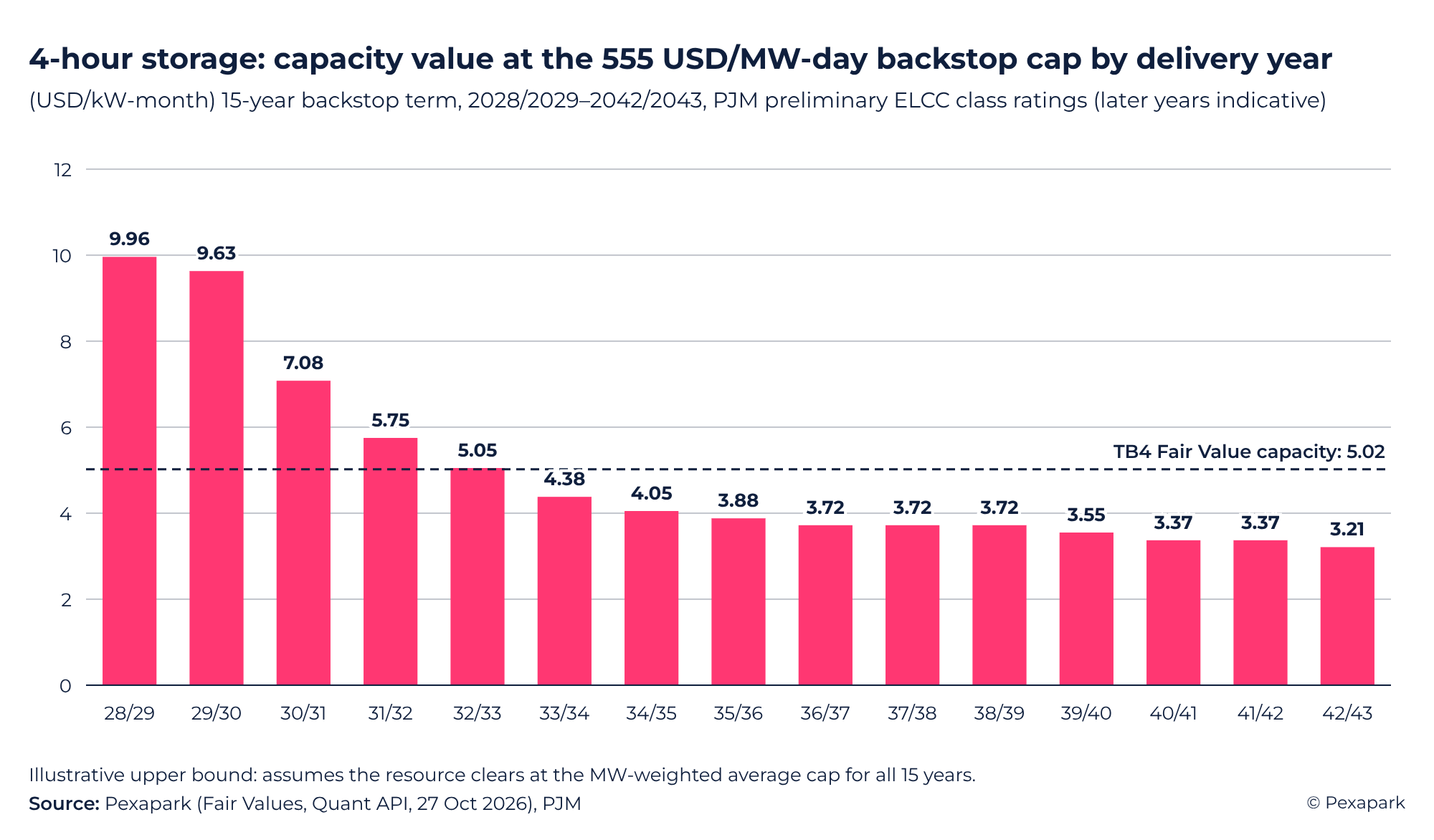
Pexapark’s PJM Composite 7-yr TB4 Fair Value, Perfect including capacity, moved from 14.33 USD/kW-month on 30 October to 14.16 USD/kW-month on 6 November, as lower average top prices cut the energy value from 9.31 to 9.14 USD/kW-month (2). Adding the ~5 USD/kW-month 15-year capacity average to that energy value gives ~14.1 USD/kW-month, in line with today’s TB4 Fair Value.
We expect the backstop to keep offers for new PJM solar firm through 2027, because it sets a 15-year price signal above the auction cap and charges the large loads driving the shortfall. The backstop also gives large loads a reason to sign capacity-backed PPAs and tolls before the March offer window. For 4-hour batteries, falling ratings make the signal much weaker than the cap suggests, and a smaller target or Exelon’s 4 November FERC complaint seeking prompt capacity auctions would weaken it further.
Navigating ERCOT & PJM Clean Power Markets?
Learn how Pexapark’s price intelligence helps you spot market opportunities and act with confidence. Book a demo >