


How Utilities and Traders Price BESS Tolling Agreements
Tolling agreements offer BESS asset owners a predictable, fixed revenue stream. In this third part of our BESS Brief series, we explore how tolling providers price these contracts – drawing on key insights from Pexapark’s newly published Reported Tolling Prices for the German market.
What is a tolling agreement?
Under a tolling agreement, the tolling provider (or “toller”) obtains the right to physically control and operate the asset across various markets – including day-ahead, intraday, and ancillary services. In exchange for granting the operational control, BESS asset owner receives a fixed fee (the “toll”). This structure effectively transfers merchant and performance risks to the optimizer, allowing the asset owner to secure stable and predictable returns.
Established utilities and trading houses – those with the necessary creditworthiness, balance sheet strength, risk appetite, and market management capabilities – are typically the key players offering such tolling agreements. But how are these contracts priced?
How do tolling providers price toll contracts for BESS?
Key components in toll pricing
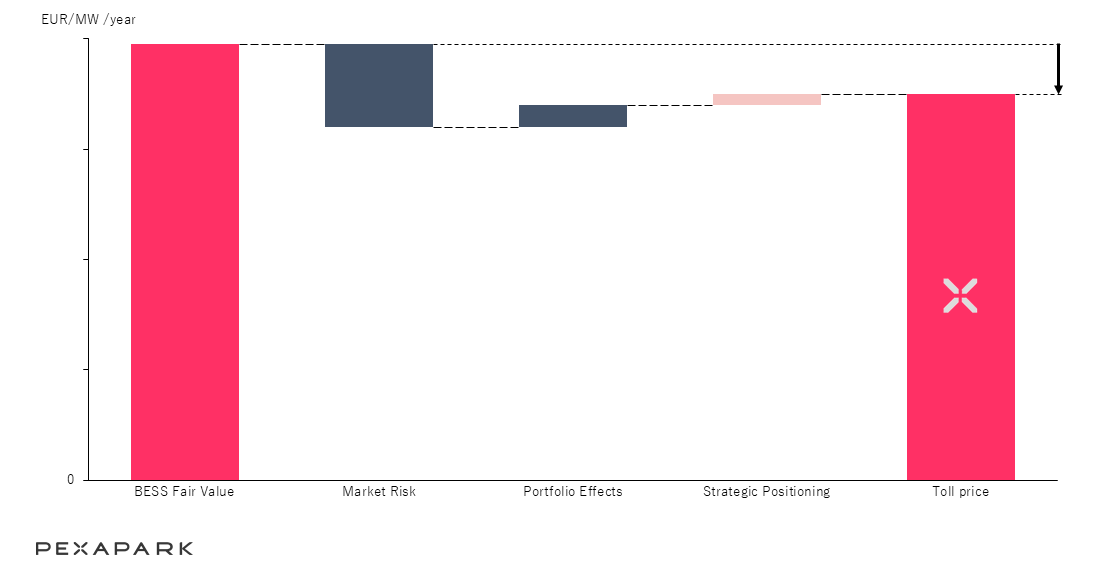
The way these players price toll is often based on the BESS Fair Value (FV), adjusted downward to account for market risks, and upward to reflect strategic value and optionality. Sounds familiar? This approach is similar to how utilities price renewable PPAs, although with a few key differences specific to the BESS business model.
BESS Fair Value
This represents the merchant value the tolling provider believes it can generate from market participation using the asset. It is based on:
Revenue Potential: the expected forward returns from
- Day-ahead and intra-day arbitrage, influenced by:
- Absolute power price levels in day-ahead and intra-day markets
- Price volatility (i.e. the dispersion of prices around the mean)
- Price shape (e.g. the spread between highest and lowest priced hours within a day)
- Market liquidity, or the ability to find counterparties, which affects trading efficiency and transaction costs
- Ancillary services, such as FCR, aFRR
How are BESS tolls priced by utilities and traders?
You’ve finished the free section of this article – the full analysis is available exclusively to Premium Pexapark users on our platform.
If you want to continue reading and don’t have a Premium Pexapark account, Schedule a call with our sales team to discuss your subscription options here.
Alternatively log in to your Premium Pexapark account to continue reading this analysis.
Don’t miss the second half of this article where we delve into:
- The risk discounts applied that account for uncertainty and potential underperformance – which includes market, credit, contractual and operational risks.
- Value additions and upside adjustments that impact pricing
- A market snapshot looking at current tolling price levels in the German market
